
For HRS, the property owner applies.
Home Renovation Savings requires the homeowner to apply when the home has tenants. A tenant cannot submit the heat-pump application on the owner’s behalf. The participant must also be responsible for the purchase and installation cost under the stream requirements.
That means a landlord’s project and a renter’s request for assistance should begin with different conversations. An owner comparing contractors needs a property-specific quote and program review. A renter who wants a more comfortable home should first identify the current heating arrangement and discuss the concern with the owner.
We find it useful to create a simple contact sheet for planning: the owner who approves the work, the resident who arranges access, the contractor who manages installation and the person who will receive service calls. It prevents avoidable confusion when scheduling moves beyond the first quote.
Describe the heating boundary before the address.
A detached rental home and a unit in a building with several residences may look similar in an online application. Their heating arrangements can be very different. Record which spaces share a furnace, boiler, ductwork, outdoor unit, thermostat and utility meter.
The HRS heat-pump requirements allow certain individual duplex, triplex and stacked-townhome units only with their own independent heating system and, for Enbridge customers, their own meter. Ask the program to review the actual arrangement rather than assuming the entire building qualifies.
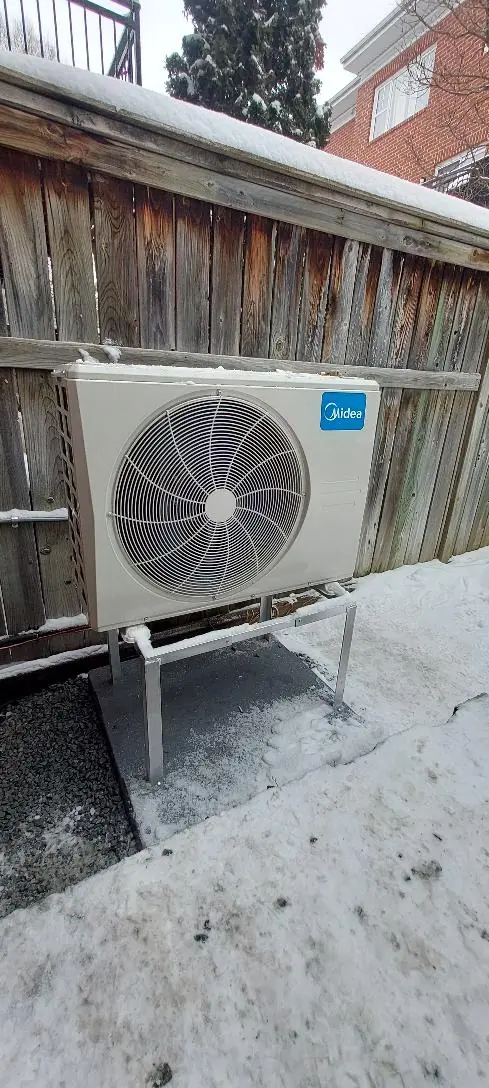
This heating boundary is also essential for a useful installation proposal. An outdoor unit serving two occupied units, or ductwork crossing between residences, needs to be understood before equipment is selected. Explain any basement suite, addition, converted room or separate thermostat to the contractor.
Bring a basic floor-plan sketch to the assessment. It does not need architectural detail. Show occupied rooms, current heating equipment and the areas that are uncomfortable. The goal is to make the service area clear enough that the quote addresses the real property.
Some electrically heated renters can check EAP.
Save on Energy states that both homeowners and renters in electrically heated homes may apply for its heat-pump assistance route. Eligibility remains subject to the Energy Affordability Program and the home assessment. The current oil-heating heat-pump route is limited to homeowners with above-ground oil tanks.
If this may fit your household, use the official EAP application and delivery partner. Do not privately buy a system expecting the assistance program to reimburse the invoice. Its heat-pump support is arranged through the program after eligibility and the home are assessed.
Ask the delivery partner what permission and access arrangements are needed when equipment belongs to the landlord. Save on Energy says it does not disclose the personal financial information used to establish a renter’s eligibility when offering landlord-owned appliance or insulation upgrades. Keep financial documents within the authorized application process.
Discuss the operating plan with the bill payer.
An owner may pay for the heat pump while the resident pays for electricity. Before installation, explain which fuel the system will use, whether another heating system remains and who controls the thermostat. The person living with the settings should understand the intended operation.
Ask for an operating-cost comparison using the property’s actual bills and the proposed system. A lower equipment rebate or a higher efficiency rating does not establish the future utility bill on its own. Record the assumptions and avoid presenting estimated savings as a guaranteed change to monthly household costs.
Also agree on practical responsibilities: filter access, routine cleaning, service appointments and who to contact if the home is not maintaining temperature. A resident should not need to experiment with unfamiliar controls to discover the backup-heating arrangement during a cold night.
For a ductless proposal, discuss room use and doors. A bedroom, home office or separate living area deserves a specific explanation of how it receives heat. Invite the contractor to walk through the occupied layout, rather than relying only on a photograph of the exterior.
Renting the property and renting the equipment are separate.
The “rental” category on the HRS heat-pump page refers to renting the heat-pump equipment. It does not mean that every tenant receives that rebate. Property ownership requirements still apply, and equipment rentals use their own rebate schedule.
For an equipment-rental proposal, compare the payment schedule, contract length, included service, repair obligations and terms for ending or transferring the agreement. Ask for the total commitment in writing alongside the purchase quote. A lower first payment is only one part of that comparison.
Keep tenancy questions separate from the HVAC quote. This guide does not determine changes to rent, leases or utility responsibilities. Those decisions need their own review before the owner or resident makes a commitment.
Use a short written project brief.
Summarize the current heating system, property layout, owner contact, resident contact, bill payer and proposed program route in one page. Give the same brief to each contractor. It makes competing quotes easier to understand and gives everyone a shared record of what the project is intended to accomplish.
For properties in AirZone’s Ottawa service area, we can review the heating equipment and installation options with the owner. Across Ontario, begin with the official program route that fits the applicant and the home, then arrange the property assessment.
Questions homeowners ask.
Can a tenant apply for an HRS heat-pump rebate?
No. For a home with tenants, the property owner must apply and meet the current HRS participant requirements.
Can a renter receive a heat pump through EAP?
Electrically heated renters may apply. The program must confirm household and home eligibility. Its current oil-heating route is for homeowners with above-ground oil tanks.
Sources behind this article.
PUT THE GUIDANCE TO WORK
Find the next step for your home.
Check the Ontario program route first, then use the buying tools to organize your questions. Ottawa-area homeowners can choose an AirZone assessment when they are ready.